When Divorce Becomes Necessary: A Honest Look at One of Life’s Hardest Decisions
- Relationship
Advik
- 0
- 19 minutes read
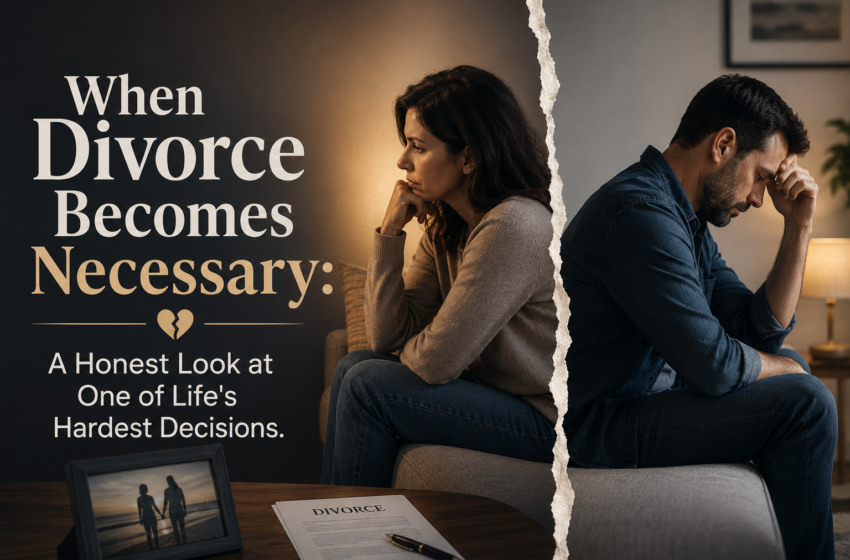
Nobody walks down the aisle thinking about an exit. You stand there, heart full, making promises you fully intend to keep. And then life happens. Years pass. The person standing across from you starts to feel like a stranger, or worse, like someone you actively dread coming home to.
Divorce is one of the most painful decisions a human being can make. It carries grief that doesn’t announce itself in a single moment but spreads quietly, soaking into everything. And yet, for millions of people, it is also the most necessary decision they ever make. The bravest, even.
So when does it become necessary? Not just hard. Not just disappointing. But truly, genuinely necessary?
That’s what this piece is about.
First, Let’s Acknowledge How Hard This Question Is
We live with two contradictory cultural messages about marriage. One says commitment is sacred and you should fight for it no matter what. The other romanticizes finding your “true self” and leaving anything that dims your light.
Neither of these is a complete truth.
The reality is messier and more human than either extreme. Most marriages don’t fall apart because one person is a monster and the other is a saint. They unravel because of accumulated distance, unhealed wounds, incompatibility that only time reveals, or needs that simply cannot be met within that particular relationship.
Divorce is not failure. It’s a recognition. And understanding when to recognize it honestly may be one of the most important things a person can ever do for themselves and their children.
The Emotional Landscape: What Your Feelings Are Telling You
When Love Has Been Replaced by Contempt
Relationship researcher John Gottman spent decades studying couples and identified contempt as the single greatest predictor of divorce. Not conflict. Not disagreement. Contempt. The eye roll. The dismissive sigh. The way your partner summarizes everything you say in the least charitable way possible.
When you stop seeing your spouse as a flawed human being you love and start seeing them as someone fundamentally below your regard, something has corroded at the root. Love can survive anger. It can survive boredom. It can even survive betrayal, in some cases. But contempt is corrosive in a way that is very difficult to reverse.
If you feel contempt for your partner consistently, or you feel it directed at you constantly, that is a serious sign. Therapy can help, but both people have to genuinely want to rebuild. If only one person is sitting in that room trying, the room isn’t big enough to save the marriage.
When You Feel More Alone Inside the Marriage Than You Would Outside It
Loneliness inside a marriage is one of the most confusing kinds of pain. You have a partner. You share a bed, a home, a life on paper. And yet you feel profoundly unseen.
This loneliness, when it becomes the baseline rather than a temporary dip, is worth taking seriously. Human beings need to feel known by the person closest to them. When years of trying to be known have been met with indifference, deflection, or emotional unavailability, the marriage has stopped being a source of connection. It has become the reason for disconnection.
Staying in a marriage like this is not noble. It is slow erosion.
When Your Mental Health Is Consistently Suffering
This one is important and often overlooked. There is a pervasive idea that enduring a difficult marriage is somehow morally superior to leaving it. That struggle builds character. That every marriage is hard.
But there is a difference between a marriage going through a hard season and a marriage that is actively destroying your sense of self.
If you are anxious every day. If you have stopped recognizing yourself. If you feel smaller, less capable, less worthy year after year inside this relationship, your body and mind are communicating something critical. People are not meant to spend their one life feeling like they are disappearing.
When Hope Has Genuinely Left
There is a specific quality to the hopelessness that signals the end is near. It isn’t dramatic. It is quiet. You stop imagining a better future together. You stop caring whether your partner had a good day. You stop wanting them to change because you’ve stopped believing it would even matter.
When hope leaves, it usually doesn’t come back on its own. And without hope, there is no real engine for the work that staying requires.
The Practical Realities That Matter Enormously
Abuse: A Non-Negotiable
Physical abuse is an obvious line. But abuse wears many faces, and it’s worth naming them plainly.
Emotional abuse, where one partner systematically undermines, controls, humiliates, or isolates the other, is no less damaging for being invisible. Financial abuse, where one partner controls all money to ensure the other cannot leave, is a form of entrapment. Sexual coercion within marriage is real and harmful. Verbal abuse that makes a person feel worthless, stupid, or crazy is abuse.
In any situation involving abuse, divorce does not just become necessary. It becomes urgent. No amount of counseling, prayer, or willpower will reliably change a genuinely abusive dynamic. The most important thing in an abusive situation is safety, and sometimes safety means leaving.
If you are in this situation, please reach out to a domestic violence organization before anything else. Leaving an abusive relationship requires careful planning, and you should not do it alone.
When Children Are in the Picture
This is where the conversation gets especially complicated, because children are everyone’s first concern and yet the arguments people make on their behalf often contradict each other.
Staying together for the kids is, in many cases, not the gift it appears to be. Children raised in a home full of tension, silence, resentment, or open hostility do not experience that as stability. They experience it as a baseline. They internalize the idea that this is what intimacy looks like. Many carry that blueprint into their own adult relationships.
Children who grow up watching their parents treat each other with disrespect learn more from what they observe than from anything they are told about love and relationships.
At the same time, divorce is disruptive. It changes children’s lives in real and sometimes lasting ways. The question is not whether there will be impact but what kind. A thoughtful, cooperative divorce where both parents remain present, kind, and child-focused causes far less damage than a bitter, contested one.
If children are involved, the goal is not simply to stay or to leave. It is to make the decision with their wellbeing at the center of every subsequent choice, including how you talk about the other parent, how you handle custody transitions, and how you manage your own grief so it doesn’t spill onto them.
Financial Entanglement
Divorce is expensive. This is not a reason to stay in a bad marriage, but it is a reason to go in with clear eyes. There are attorney fees, court costs, potential division of debt, changes in housing, and in some cases, dramatic shifts in lifestyle.
People, especially those who have been financially controlled within a marriage, may feel trapped by the practical math of it. But it’s worth understanding that staying in a financially abusive marriage or a high-conflict marriage has its own enormous costs, including the toll on health, career, and quality of life.
Before making any decisions, consult with a family law attorney in your area. Many offer initial consultations at low or no cost. Knowledge about your actual situation is far more useful than anxiety about the worst-case scenario.
When One Person Has Already Left in Every Way That Matters
Sometimes divorce becomes necessary not because of a dramatic event but because one person has emotionally, physically, or romantically exited the marriage long before any legal proceedings begin. They may still be living in the house. But they are gone.
This can look like a partner who refuses to engage in any conversation about the relationship for years. A partner who has maintained a long-term affair and shows no genuine remorse or intent to stop. A partner who prioritizes every other relationship, hobby, or obligation over the marriage consistently and permanently.
When one person has quietly decided the marriage is over but won’t say so, the other person is left in an agonizing limbo that serves no one. In cases like this, naming the reality that already exists is not destruction. It is honesty.
What Staying Looks Like When You Should Go
One of the most underexamined aspects of this conversation is what happens when people stay past the point when they should have left.
They become bitter. Not because they are bad people, but because years of suppressing their own needs and truths accumulates. It comes out sideways, in coldness toward children, in health problems, in midlife explosions, in a slow grinding down of everything that was once vital about them.
There is a particular kind of person who stays not out of love but out of fear: fear of being alone, fear of financial instability, fear of judgment, fear of the unknown. And those fears are real. They deserve compassion. But they are not reasons to spend a life.
Staying in a dead marriage out of fear eventually produces the very thing you feared: a version of yourself that is diminished, resentful, and disconnected.
What Leaving Doesn’t Solve
This also needs to be said clearly.
Divorce is not a cure for unhappiness. It is not a reset button. It is not proof that you are brave or evolved or finally prioritizing yourself. People who leave bad marriages sometimes discover, painfully, that they have carried themselves right into the next relationship and repeated the same patterns.
If you leave without doing the internal work, you take the wound with you.
Divorce does not automatically produce the life you imagined. There is grief that surprises you. There is loneliness that is different from the loneliness you left, but no less real. There are practical difficulties that you did not anticipate.
This does not mean you made the wrong choice. It means divorce is a beginning, not an ending. The work of understanding what happened in the marriage, what role you played, what you need, and what you are capable of in relationship continues long after the paperwork is signed.
The Role of Therapy: Before, During, and After
Individual therapy before a divorce decision is not about being talked out of it. It is about making sure the decision comes from clarity rather than panic, impulse, or fear. A good therapist will not tell you what to do. They will help you understand what you actually want, separate from what you think you should want.
Couples therapy, when both people are genuinely willing, can sometimes repair what seems broken. But it requires both partners to be honest about their own role in the dynamic. Therapy where one person is performing willingness while the other is doing all the actual work is not really couples therapy. It is one person working very hard while the other watches.
And if you have children, co-parenting therapy after a divorce is one of the most practical investments you can make in their wellbeing.
The Spiritual and Cultural Weight
For many people, religious beliefs about the permanence of marriage create enormous guilt and internal conflict around the idea of divorce. This is real and deserves acknowledgment.
Different faith traditions hold different views. Some allow divorce in cases of abuse, abandonment, or infidelity. Some do not. Wrestling with what your faith means to you in the context of a real, lived marriage is deeply personal work.
What is worth saying is this: most spiritual traditions, at their core, are concerned with human dignity, compassion, and flourishing. A framework that requires a person to endure abuse, contempt, or profound suffering in perpetuity in the name of vows is one worth examining carefully, ideally with a spiritual advisor who is compassionate rather than merely rule-bound.
So When Does Divorce Become Necessary?
There is no single answer. But here is an honest attempt at one.
Divorce becomes necessary when the marriage has become genuinely harmful rather than merely difficult. When one or both people have truly stopped being able to see the other with any warmth or goodwill. When safety is at stake. When the fundamental incompatibility cannot be bridged regardless of effort. When both people, or one person who has tried alone for long enough, have nothing left.
It becomes necessary when staying would require both people to spend their lives performing a relationship that no longer exists in any real sense.
And perhaps most importantly, it becomes necessary when, after honest reflection, counseling, real effort, and real time, you can say that you have genuinely tried and you are genuinely done.
That is not nothing. That is not failure. That is the hardest kind of integrity.
A Final Word
Divorce is not the end of your story. It is a turning point in it. The people who navigate it with the most wholeness are usually the ones who grieve it properly, who take responsibility for their part in what happened, who protect their children fiercely, and who eventually come to understand that a life lived honestly, even a painful one, is better than a life lived in silence.
You are allowed to leave something that is no longer working. You are allowed to want more than endurance. You are allowed to choose a different life.
And you are also allowed to stay and fight for something, if it is genuinely worth fighting for, and if fighting for it still feels like love rather than fear.
Only you know which is which. And that knowing, when it finally arrives, is usually quiet, certain, and completely your own.