How to Stop Overthinking
- Health Health Tips
Advik
- 0
- 14 minutes read
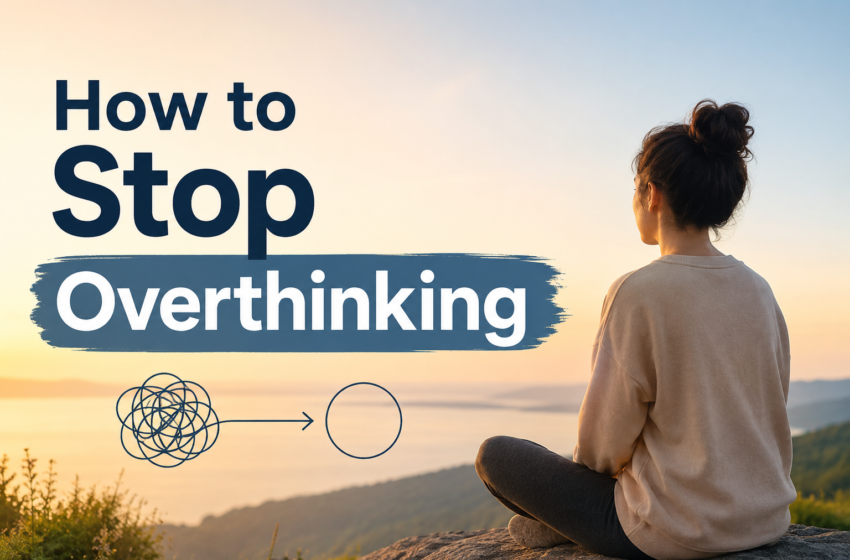
“The mind is a beautiful instrument, but it becomes a burden when we allow it to dominate our being instead of serving our true essence.”- Osho
We live in an age of noise. Not just the noise outside: the traffic, the notifications, the headlines, but the relentless noise inside. The mind that replays conversations. The mind that catastrophizes tomorrows that haven’t arrived. The mind that never, ever seems to stop.
If you’ve ever lain awake at 2 a.m. trapped in your own thoughts, you already know this truth: the mind, when left unchecked, becomes your prison. But here’s the radical insight: you don’t need to fight it. You don’t need to silence it by force. You simply need to see it for what it is.
You Are Not the Mind
The single most liberating idea is: you are not your thoughts.
Most of us have spent our entire lives believing we are the voice in our head. Every worry, every self-criticism, and every anxious spiral we take it as the truth of who we are. But this is the root of all suffering.
“Mind is maya, mind is just a dream, mind is just a projection… a soap bubble — nothing in it, but it appears like a soap bubble floating on a river.”
A soap bubble. It looks real. It catches light. It floats convincingly. And then it’s gone.
Overthinking feels so heavy precisely because we have identified with the thought. We don’t observe the thought; we become it. The moment someone criticizes us, we don’t see a thought arising (“they disapprove of me”), we collapse into it. And from inside a soap bubble, the whole world looks distorted.
The first step is simply this: step outside the bubble. Not by fighting thoughts, but by realizing you are not them.
The Art of Witnessing
So if you are not the mind, then who are you?
The answer is breathtaking in its simplicity: you are the witness. The one who watches.
“Just by being a simple witness of your thought processes. It is simply sitting silently, witnessing the thoughts passing before you. Just witnessing, not interfering, not even judging, because the moment you judge, you have lost the pure witness.”
This is not suppression. It is not a distraction. It is not positive thinking. It is something far more radical- pure observation.
Imagine sitting on a riverbank and watching the water flow. You don’t jump in and wrestle the current. You don’t try to stop the river. You simply watch. Thoughts are exactly like that river. They come. They pass. They are not you.
The problem is that most of us don’t sit on the riverbank; we leap into the water and then wonder why we’re drowning in our own minds.
“Thoughts are passing, desires are moving, memories are coming and going like clouds in the sky, and you are sitting silently simply watching, not doing anything.”
The practice, then, is deceptively simple: watch your thoughts without becoming them. Notice the worry arise. Notice the spiral begins. But stay on the bank. Don’t jump in.
Overthinking is a Fear of Feeling
Here is something most of us instinctively avoid: we don’t overthink because we love thinking. We overthink because we are afraid to feel.
Beneath every anxious spiral is an emotion that the mind is desperately trying to avoid — grief, shame, loneliness, fear. The mind creates elaborate stories and analysis to sidestep direct contact with these feelings. Someone feels guilty, and the mind immediately starts building a case- “you’re terrible,” “you should have known better” — because it is easier to think about guilt than to actually sit with the raw sensation of it.
This escape doesn’t heal. It only delays. To truly quiet the mind, you must be willing to feel what the mind is running from.
“To heal, we must feel. And to feel, we must stop thinking for a while.”
This is not about wallowing in pain. It is about giving your emotions the dignity of your full attention for just a moment so they no longer need to grab your mind and spin it in circles.
The Present Moment is the Only Reality
Overthinking is almost always a time problem. The mind lives either in the past or the future. It replays what happened, rehearses what might happen, and in doing so, it completely misses now.
“The present is the only reality, but the mind does not like the present because it is uncontrollable and uncertain. The mind prefers to analyze what has already happened or predict what might happen. In this endless movement between yesterday and tomorrow, we lose today.”
Anxiety grows in the gap between where we are and where the mind imagines we should be or fears we’ll end up. The present moment has no such gap. It simply is.
This is why meditation always brings people back to the breath, back to the body, back to this exact moment. Not as a technique of escape, but as the most direct route to reality. When you are fully here– tasting your tea, feeling your feet on the ground, hearing the sounds around you — there is no room for the mind to spin its stories.
No-Mind: Not Against the Mind, But Beyond It
“No-mind” is a widely misunderstood idea. People hear it and think it means the destruction of thinking, the death of intelligence. It means something entirely different.
“No-mind is not against mind: no-mind is beyond mind. No-mind does not come by killing and destroying the mind: no-mind comes when you have understood the mind so totally that thinking is no longer needed — your understanding has replaced it.”
The goal is not to become a vegetable. The goal is to use the mind as a tool — brilliant, sharp, creative — rather than being enslaved by it. A hammer is a wonderful thing. But you don’t carry a hammer everywhere and swing it at everything you see.
Dynamic Meditation was designed precisely for modern people who are too caught in the head. It begins with vigorous, chaotic movement to shake loose the grip of the thinking mind, and ends in silence not a forced silence, but the natural silence that emerges when the mind has been given permission to release.
The sequence matters: release the noise actively, then rest in stillness. Don’t try to force stillness onto a mind still buzzing with suppressed energy. Give the mind its catharsis first.
The Practice: How to Actually Do This
Here is what all of this translates into, concretely:
1. Sit and watch. Set aside ten minutes. Close your eyes. Don’t try to stop thinking. Simply watch every thought that arises. Name it if you like — “planning,” “worrying,” “replaying.” You are not your thoughts. You are the one noticing them.
2. Feel before you think. The next time anxiety strikes, pause. Before you let the mind start spinning, ask: what am I actually feeling right now, in my body? Locate the sensation. A tightness in the chest? A heaviness in the stomach? Stay there for thirty seconds. The mind’s compulsive need to analyze often loosens the moment the feeling is directly met.
3. Return to now. When you catch yourself time-traveling into regret or dread, take three conscious breaths. Feel the air entering your body. Feel the ground beneath you. You have returned to the only moment that exists.
4. Release before you silence. If the mind is too agitated for quiet sitting, the prescription is: move first. Dance vigorously, shake your body, and speak gibberish aloud for a few minutes. Let the stored tension discharge. Then sit in stillness. The silence that follows active release is natural and deep.
5. Don’t judge the thoughts. This is crucial. The moment you say “I shouldn’t be thinking this,” you have entered the mind’s game. A good thought, a bad thought to the witness, they are the same. They are clouds. You are the sky.
The Surprise That Awaits
There is a promise for anyone willing to genuinely try this. It is not a small thing.
“Once the gap is there, you are in for a great surprise, that you are not the mind, that you are the witness, a watcher. And this process of watching is the very alchemy of real religion.”
The great surprise is freedom. Not the freedom of a quieter mind, though that comes too but the freedom of knowing who you are when the mind goes still. Beneath all the overthinking, beneath all the analysis and the fear and the stories, there is something that has never been disturbed. Something that watches it all with perfect equanimity.
This is your true being. And it is available to everyone, at any moment, without cost or condition. You don’t earn it. You don’t achieve it. You simply stop mistaking the noise for yourself.
The thoughts will still come. But you, on the riverbank, will smile and watch them pass.
“You are not the mind. You are the silence that remains when the ego dissolves, revealing the divine essence within.”